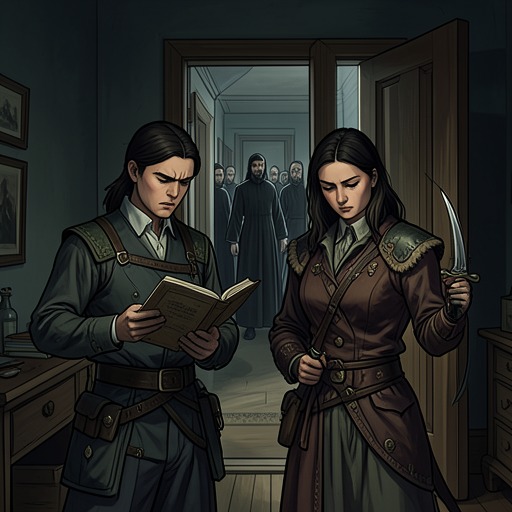
Allison Argent–Gerard Argent relationship
Holding Out for a Hero ▸ Stiles Stilinski (2)The Allison Argent–Gerard Argent relationship is a family bond shaped by affection, surveillance, inherited hunting knowledge, and coercive authority. Gerard Argent’s arrival in Beacon Hills makes the relationship politically consequential: as Allison Argent’s grandfather and the new principal of Beacon Hills High School, he can monitor her movements, regulate her access to Scott McCall, and place the Argent family’s supernatural agenda inside the school itself. Allison remains connected to him through family, but the narrative repeatedly shows that this connection is also a source of pressure and danger.
Family Bond and Emotional Context
Allison’s relationship with Gerard is presented within a wider pattern of family intimacy complicated by absence, secrecy, and loss. Carson Bradley reflects that Stiles Stilinski’s mother was a sensitive subject because Carson’s own mother had disappeared from her life two years after Mrs. Stilinski’s death. That comparison establishes why family bonds in Beacon Hills carry unusual emotional weight: relatives are not merely sources of comfort, but figures whose disappearance, silence, or hidden knowledge can reshape a young person’s identity.
Gerard’s position in Allison’s life therefore exceeds that of an ordinary grandfather. He belongs to the Argent family and embodies its inherited knowledge of supernatural creatures. Scott learns from Deaton that Allison’s family keeps a record of the different things it has hunted, a vast archive imagined as a book. The bestiary makes the family’s history material and transmissible, while Gerard represents the living authority behind that history. Allison is connected to a tradition that gives her knowledge and power, but also supplies the rules through which her family judges werewolves and other supernatural beings.
Gerard’s Authority at School
The relationship changes sharply when Gerard takes over Beacon Hills High School as principal. His authority does not remain inside Argent House or the family’s hunting practices; it enters the daily environment where Allison, Scott, Carson, and Stiles must study and meet. Since Gerard has taken over as principal, Allison and Scott barely have time even to look at one another. Their movements are tracked, making ordinary romantic contact risky and turning school corridors into a monitored extension of Gerard’s control.
This surveillance forces Allison to communicate with Scott indirectly. Carson and Stiles become the only people the couple trusts to carry their affectionate messages, so Allison’s relationship with Scott is routed through the friends who can move between them. The arrangement reveals Gerard’s power through its consequences rather than through a single confrontation: he does not need to forbid every conversation aloud when his presence makes the couple police their own behavior.
Gerard’s control also places Carson and Stiles in an unexpectedly important position. They are not simply confidants for Scott and Allison; they become intermediaries created by the pressure of Allison’s family. Their involvement shows how Gerard’s authority reorganizes the social world around Allison, compelling friends to participate in concealment and communication while the family conflict intensifies.
Knowledge, Hunting, and Moral Pressure
The Argent family’s bestiary gives the relationship an intellectual and institutional dimension. Allison knows that her family records the supernatural beings it has hunted, and she identifies Carson as someone who may help translate the nine-hundred-page volume written in archaic Latin. Her connection to Gerard thus carries access to knowledge that the others need, even when Gerard himself is an obstacle. Family inheritance becomes both a resource for resistance and an instrument of control.
Allison’s awareness of the family archive also places her between generations. Gerard treats supernatural knowledge as part of the Argent legacy, while Allison and her friends use that legacy to investigate threats and protect people. The same family record can support a hunter’s campaign or help adolescents understand the creatures being targeted. This tension makes Allison’s bond with Gerard more complex than simple obedience: she inherits the family’s tools but does not necessarily accept the purposes to which Gerard puts them.
The conflict becomes immediate when four werewolves wait to kill Lydia Martin. Allison considers calling her father despite knowing that Gerard’s family is already deeply involved in the danger. Carson warns that the situation is especially perilous if Allison’s father finds her there, because both Allison and Scott could be exposed. Allison still recognizes that the werewolves are not merely trying to frighten Lydia; they intend to kill her. Her impulse to involve her family shows the continuing pull of Argent protection, even as the family’s presence threatens to worsen the situation.
Conflict Between Kinship and Choice
Allison’s relationship with Gerard is defined by a conflict between belonging and judgment. Gerard’s family gives Allison a history, a vocabulary, and access to the bestiary, but his role as principal converts that inheritance into surveillance. Allison’s personal loyalties—to Scott, to Carson, to Stiles, and to Lydia—therefore develop under the pressure of a grandfather whose authority is both familial and institutional.
The image of Allison wearing Gerard’s jacket captures this ambiguity. Carson notices the jacket wrapped around Allison just as a plan is beginning to take shape and realizes that the moment has become decisive. The garment signifies Gerard’s presence, family affiliation, and public authority, but it is also something Allison can wear while acting within a plan that the older generation may not control. His symbol is present on her body without fully determining her actions.
The relationship consequently functions as a generational struggle over what inherited power is for. Gerard’s authority links the Argent family to a tradition of hunting and classification, whereas Allison’s choices test whether that tradition can coexist with sympathy, friendship, and protection. The available evidence does not establish a final reconciliation between Allison and Gerard. It does establish the central pressure of their bond: Allison cannot simply step outside her family, but neither can she remain untouched by the consequences of Gerard’s control.